Name
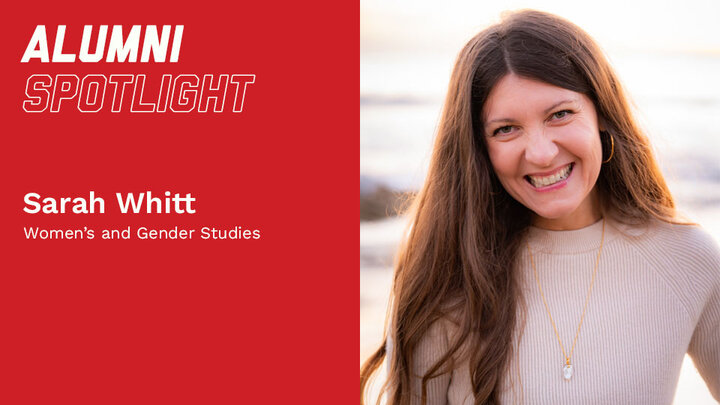
Sarah A. Whitt
Which degrees did you earn from CAS?
Undergraduate
Major(s) or area(s) of study
WGS
Graduation year
2012
Who is your employer, and where are they located?
University of California, Irvine
Irvine, CA
What is your job title and what kind of work does it involve?
Assistant Professor (currently up for tenure). As a member of the faculty in the department of Global Studies, I train doctoral students, teach undergraduate classes, serve my fields in a professional capacity, conduct original research, and publish on a wide variety of topics related to Indigenous history in the US.
What sparked your interest in your major(s) or area(s) of study?
I did my first year of college at a private liberal arts college that focused exclusively on the "classics," and quickly came to realize that the voices and perspectives of those I was most interested in--women, Indigenous people, people of color, "marginalized" historical figures--would not be represented anywhere in the curriculum. I made the decision to leave that program and enroll at UNL, selecting WGS as my major at my mother's suggestion. It became very clear to me early on, in my first semester at UNL, what a good, sound decision that had been. I had the good fortune of taking an introductory WGS course, perhaps in my first semester at UNL, with then-graduate student Kris "Stripe" Gandara. Our syllabus was electrifying--I could not wait to attend class each week. It was exhilarating to discuss power, inequality, gender, race, and how these categories structure and define our world. I will never for! get that feeling--the feeling of true intellectual awakening!
What do you see as the value of your major(s) or CAS degree?
When I was a student at UNL, I was also working in the downtown Lincoln vicinity. One afternoon when I was at work, my supervisor and his boss asked what I was studying on campus, and I told them. They chuckled, asking me what I would do with a Women's and Gender Studies degree. I am now a professor at a well-respected Research 1 university in Southern California; I have my own students, and together we discuss the ways in which power, inequality, gender, race, class, and other structures shape our world. I have been told that some of the conversations I facilitate are also perspective-shifting and life-altering; but were it not for my own experiences as a student in the WGS program, I would not have learned to quite the same degree the language that I now rely on in everyday scenarios to interpret and navigate the world. Compassionate, critical thought is in short supply these days--and while I happen to be a professor, the ability to assess and articulate complex power structures, and to wield critical thought, are broadly applicable in many fields; through the care of my own professors, I learned the value of lingering on the text, asking difficult questions, and how wonderful and personally transformative higher education can be.
Were there any other people, activities, or events from your time at UNL that helped you get to where you are now?
Many people from my time at UNL assisted me in my academic journey and the things they taught me I've carried into my professional career. I am grateful to many wonderful professors, educators, and instructors, including Jeannette Eileen Jones, Carole Levin, the late Barbara DiBernard, Mary Willis, (as aforementioned) Kris Gandara, Rose Holz, Margaret Jacobs, Timothy Schaffer, Damon Pfister, and others--as well as the many comrades and friends that I made along the way.
Tell us about the path you took to get to where you are today in your career and how you applied your education in your major(s) or area(s) of study to get here.
My career trajectory was relatively linear, although this is just one path among many. I entered one undergraduate program and realized rather quickly it was not for me; enrolled at UNL and finished my Bachelor's degree with high distinction; left for graduate school at UC Berkeley a year later, and earned my PhD as the pandemic struck the globe. After receiving my doctorate, I assumed a UC President's Postdoctoral Fellowship in the History department at UC Riverside, and a year later joined UC Irvine as assistant professor. Throughout those educational experiences and into my early career, I have drawn upon many of the lessons I learned as an undergraduate, building and expanding upon them as well. I first experienced the joy of archival research as an undergraduate, under the guidance of professors including ! Carole Le vin; I learned to formulate good academic questions and answer them as I crafted an Honors' thesis--skills that assisted me as I assumed graduate work and developed my dissertation. One of the most important things that academics and scholars do is ask powerful questions--but that is a skill that is cultivated, beginning with one's time as a student. At least, that was certainly true for me. And perhaps most importantly, I carefully noted the care that my professors--many of them women--took in guiding me; not just as their student, but as someone who aspired to a career that looked like their own. It is often the case that the labor of women in academia goes unremarked and unnoticed. But if it weren't for the many, many brilliant women (including my own mother) in academia who came before me, I could not have made it to where I am today. I received countless, invaluable kernels of life advice from these women; I am glad I had the wherewithal to pay attention when they were! offered.
What are your future professional goals?
I am currently writing my second book; I continue to publish widely in my fields, train my wonderful doctoral advisees, teach my brilliant undergraduate students, and produce scholarship that I hope will help change the way that Indigenous histories are narrated and understood--in the academy, and in the world.
January 26, 2026